The Power of Distribution
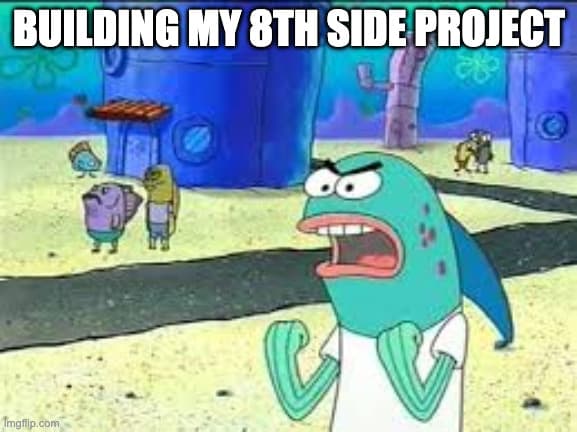
Let’s talk about the lesson that I keep relearning: building sh!t isn’t the same as people seeing your sh!t.
AI has enabled more people to be builders. It has massively lowered the cost of coding and experimentation. Anyone with a half-baked idea can spin up a product.
This doesn't mean that software engineering is dead, but any time we start changing the cost of production, it'll impact the market. In this case, I'll turn to an ECO101 breakdown of how I see this playing out.
An Econ 101 Detour (Stay With Me)
Allow me to justify my economics degree. In classic supply and demand terms:
- The supply of software projects has gone way up.
- The demand (i.e. human attention) has not meaningfully increased.
- When supply increases and demand stays flat, the price goes drops.
In this case, the “price” is the thing that people are giving up to see your product. In this case, it’s attention / time / "eyeballs" as some call it. So, in real world terms, this means that "attention per project" is dropping.
Here’s the picture:
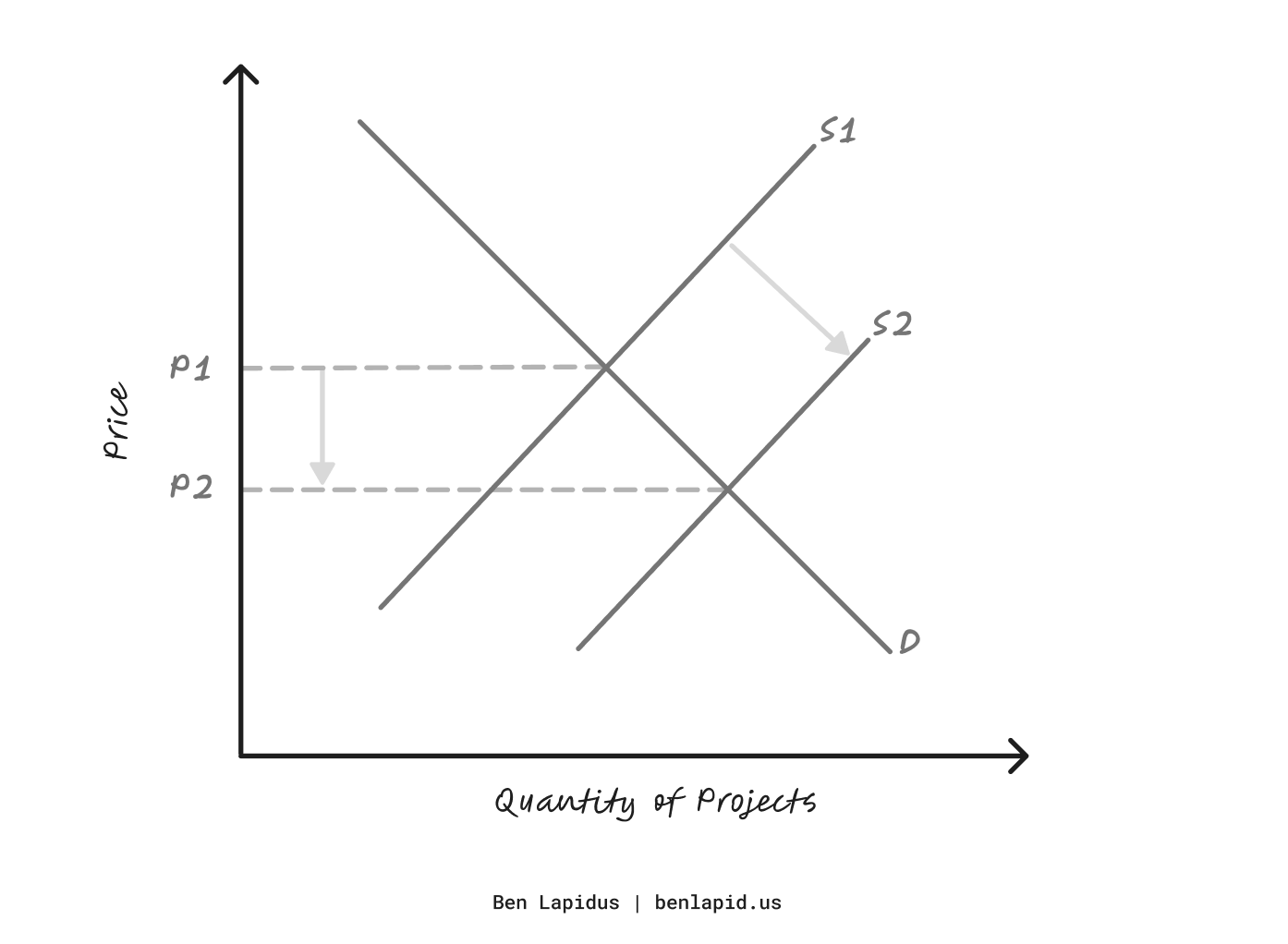
More projects chasing the same finite online audience means attention is more expensive than ever. Which leads to a slightly uncomfortable conclusion:
Even if you build something great, quality is not enough.
If two products compete in the same space, the one with stronger distribution will win. Even if you have a great UI, even if you have super clean code, even if you have a better product, distribution is the decider.
I think this is a pretty reasonable conclusion. Ask yourself: when is the last time you googled around for a digital experience? For me, it's essentially never. Most of the time, this sort of thing is sent to me or I discover it on Reddit or a blog or something. I can think of a handful of times where I’ve googled for something novel and found it. It's not a common experience because how do you search for something that you don't know exists?
This has been a painful lesson for me as an engineer, because distribution isn't necessarily a technical problem, but rather a people problem.
The Graveyard
Let’s stroll through a few projects I’ve built.
WheelOrDoor -- a site where you vote whether there are more wheels or doors in the world. Fun idea. Less than 100 people ever saw it. And I had no way to talk to a single one of them again.
BaronieHQ -- product recommendations pulled from a podcast I like. Less than 1,000 visitors. Same problem: no channel to reach them later.
SpotOn -- a quiz tool that generated trivia from your friends’ listening history. Built this with my buddy Cash and we had one user, maybe two.
TryLettra -- a project I still maintain. Total users: five. I’ve mostly paused it while I figure out distribution, because I’ve mostly learned my lesson.
I clearly don't think any of these ideas failed because they are bad ideas. I still think these have potential to be great ideas. But, there's really no way to validate that until you get in front of an audience.
Distribution in Effect: Aisle
Contrast that with the app I built at Aisle.
Last time I checked:
- ~190,000 downloads
- Launched in early 2025
- Zero paid advertising (!!!)
- Charted above the Tesla app in our category (a not-so-humble flex 💪)
I fundamentally think this succeeded because we already had a distribution network. In this case, it was a few hundred thousand people who were aware of our existance that opted in to SMS marketing.
That initial push got the flywheel spinning. Folks from our network that already trusted us were the first to take a look, and that momentum built.
This project was a first for me in that we had the distribution network, and the product came second.
The Launch Party of Zero
I hear this all the time:
“Hey Ben, I have a product idea.”
And that’s great. I love ideas! I love building! I will probably continue to build too many things.
You can have:
- A great idea
- A solid product
- Clean execution
- A fabulous team
...but still end up with no one to see it.
I'll also add that this is a lesson I'm still learning. I have a network of 26 people, but I think I need more than that to get any traction.
Anyway!
If you’d like to watch me continue learning this lesson in real time by fumbling my way toward a distribution strategy and occasionally shipping things that people actually use
...you should subscribe to this blog.
This is me very intentionally and transparently trying to build a distribution network.